Tell us about the job
Takes about a minute. No obligation.
A contractor looking at a failed central AC in Washington County will ask what wore it out, and the weather record gives them limited material to work with. 66 severe weather events were recorded in Washington County, Kentucky between 2015 and 2024. At that rate, severe weather is an occasional event here, and a compressor or capacitor that quit in this county most likely quit because of age, a weak install, or skipped service cycles. The weather load is real but modest. When a contractor quotes a repair, the system's maintenance history is what shapes both the diagnosis and the scope.
Ductwork that has served multiple systems and electrical service that has been patched across owners rarely announces a problem during a repair call. What surfaces instead is inside the unit: a capacitor that has cycled through too many Kentucky summers, a contactor worn past the point of reliable switching, or a refrigerant circuit running on a blend that is harder to source every season. Half the homes in Washington County, Kentucky were built in 1982 or earlier (2020-2024 ACS 5-year). That depth of housing history means contractors who work repair calls here open the equipment first and trace the house second, because the panel and the ducts have usually been made to work well enough by someone before them. The question that decides the scope and the bill is whether the parts this specific system takes are still in supply.
The Parts of a Central AC a Contractor Checks First
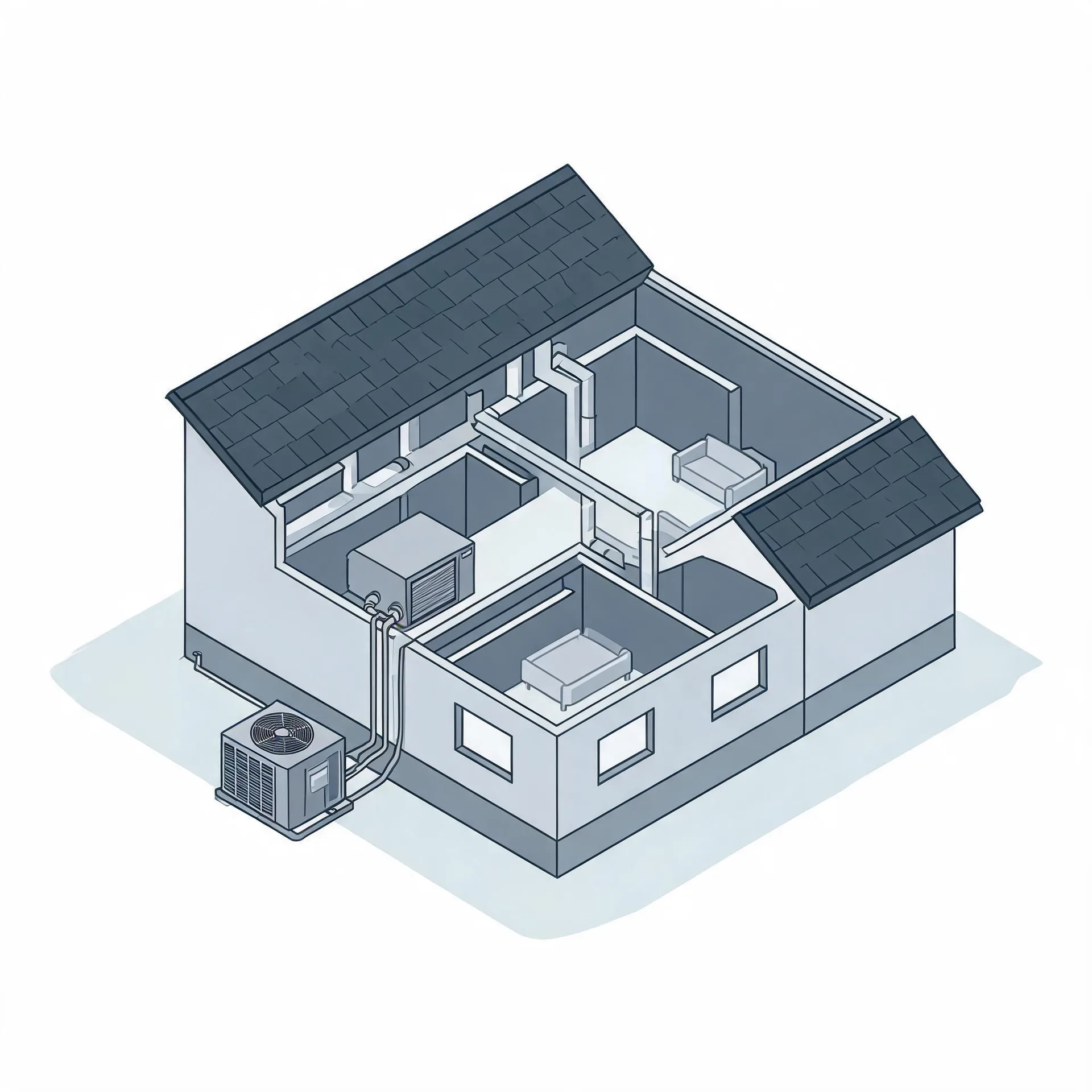
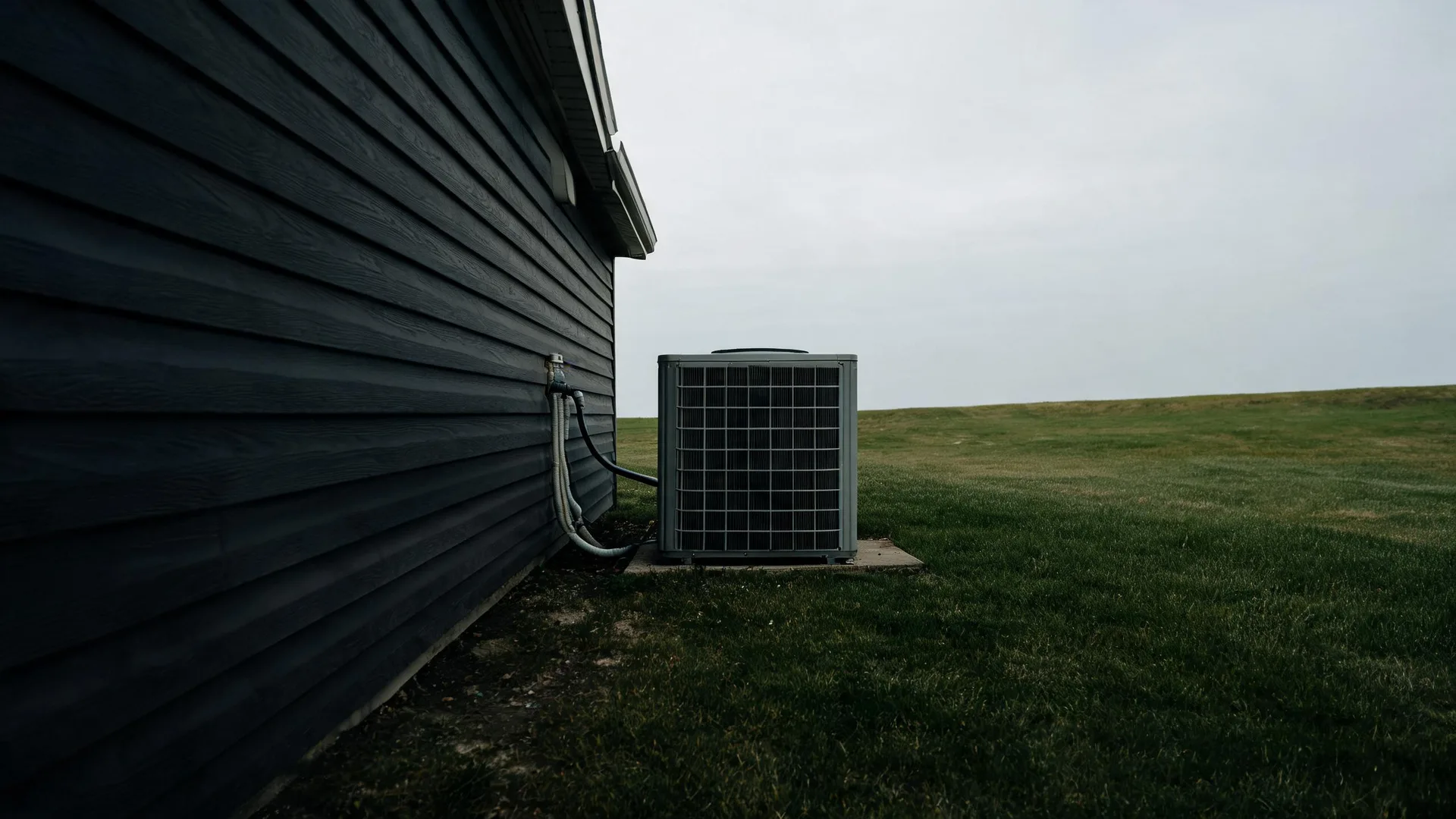
The outdoor condenser unit sits outside the house, usually on a concrete pad beside the foundation, and it carries the compressor and condenser coil. These are the pieces a contractor goes to first when the system is blowing warm air or not running at all. A failed compressor, a dirty or damaged condenser coil, or a refrigerant problem will all show up here.
Inside the house, the air handler holds the evaporator coil and the blower fan, typically in a utility closet, basement, or attic. The evaporator coil is where refrigerant does its work on the indoor air, and the blower moves that air through the house. The expansion valve and refrigerant lines connect the two units, and a fault anywhere along that path can stop the whole system.
The drawing shows the general layout of a central AC system, and a licensed contractor determines which components apply to your particular house and situation.
Get matched in Washington CountyWashington County, Kentucky, by the numbers
66 severe weather events were recorded in Washington County, Kentucky between 2015 and 2024.
NOAA National Centers for Environmental Information, Storm Events Database, bulk CSV export, events 2015-01-01 through 2024-12-31.Half the homes in Washington County, Kentucky were built in 1982 or earlier (2020-2024 ACS 5-year).
U.S. Census Bureau, 2020-2024 American Community Survey 5-Year EstimatesWashington County, Kentucky holds 5,244 housing units (2020-2024 ACS 5-year).
U.S. Census Bureau, 2020-2024 American Community Survey 5-Year EstimatesOwners occupy 77.6% of the occupied homes in Washington County, Kentucky (2020-2024 ACS 5-year).
U.S. Census Bureau, 2020-2024 American Community Survey 5-Year EstimatesRules & Standards Behind Central AC Repair in Washington County, Kentucky9 sourced rules and standards
What HVAC Repair Looks Like in Washington County
Split-system central air conditioners rated below 45,000 Btu/h manufactured on or after January 1, 2023 must meet a federal minimum of 13.4 SEER2.
Split-system central air conditioners rated at or above 45,000 Btu/h manufactured on or after January 1, 2023 must meet a federal minimum of 13.4 SEER2.
Split-system central air conditioners manufactured between January 1, 2015 and December 31, 2022 had to meet 13 SEER, the metric that preceded SEER2.
Single-package central air conditioners manufactured on or after January 1, 2023 must meet a federal minimum of 13.4 SEER2.
Space-constrained central air conditioners manufactured on or after January 1, 2023 must meet a federal minimum of 11.7 SEER2.
Federal efficiency standards for split-system central air conditioners and heat pumps are set on each certified combination of outdoor unit and indoor coil rather than on the outdoor unit alone.
Residential and light commercial air conditioning and heat pump systems assembled in the field, including mini-splits and unitary systems, may not be installed on or after January 1, 2025 using a refrigerant with a global warming potential above 700.
A field-assembled system whose specified components were all manufactured or imported before January 1, 2025 carries no installation compliance date under the refrigerant restrictions and may still be installed.
Licensing Rules That Apply in Washington County, Kentucky
Kentucky requires a licence to practise heating, ventilation and air conditioning contracting: a person may not do the work unless they have met the state licensing requirements.
Severe Weather Events in Washington County
Extreme weather puts real stress on AC equipment, cycling it hard through conditions it was never sized for a single calm season. Repair demand in Washington County follows that pattern, which is why local weather history belongs on a page about keeping your system running.
66 severe weather events, 2015–2024. Source: NOAA National Centers for Environmental Information, Storm Events Database.